Guide · FDM Materials
FDM materials by job: when to use PLA, PETG, ABS or TPU
Four filaments cover most FDM work. Picking between them comes down to three questions about where the part will live.
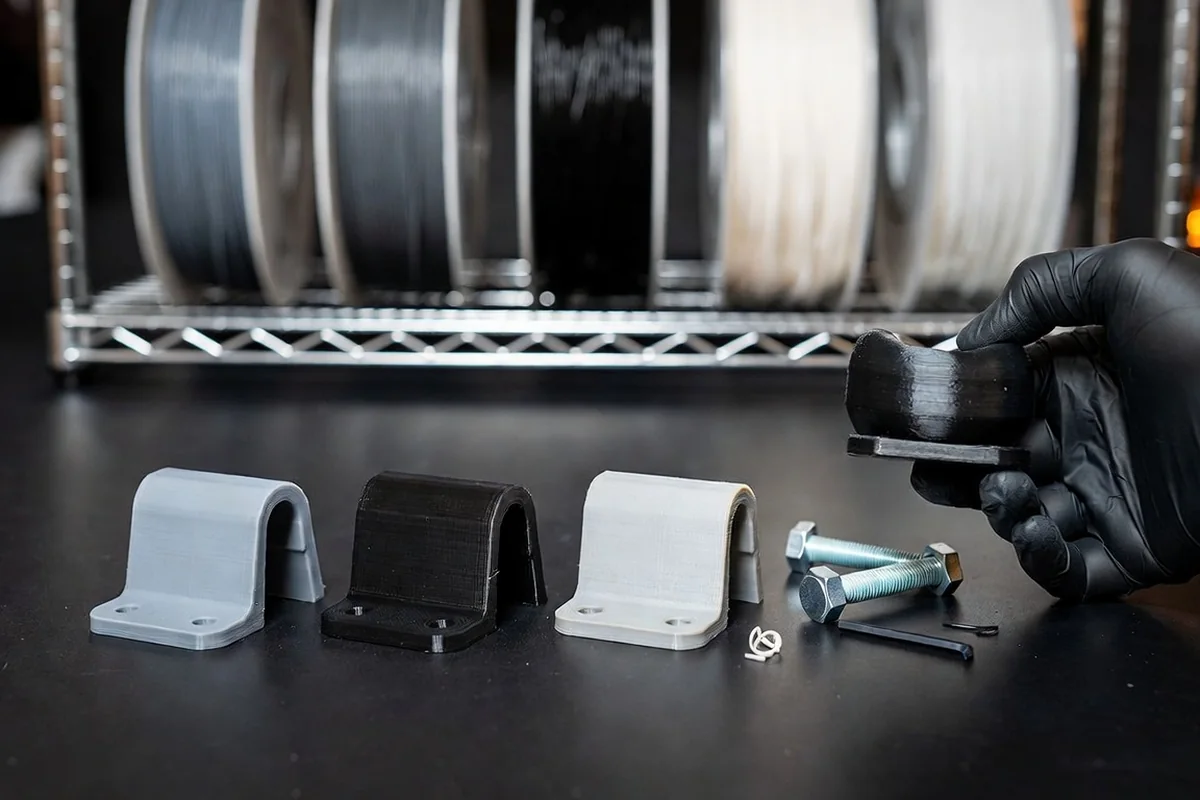
Most FDM material mistakes are the same mistake: choosing by name instead of by duty. A bracket printed in the wrong plastic looks identical on day one and can fail in its first summer. Start with the conditions and the material usually picks itself.
Three questions first
- How hot does it get? Sun through glass, a motor nearby, electronics inside.
- Does it live outdoors? UV and moisture rule materials in and out.
- Does it need to flex, grip or absorb shock? That is a different material class.
Add a fourth if customers will see the part: does the surface matter? That answer can move the job out of FDM altogether.
PLA: the starting point for prototypes
PLA is stiff, prints quickly, warps little and holds sharp corners, so the part matches the CAD closely enough to trust a fit check. It is the economical default for concept models, fit checks, massing studies and jigs that stay indoors. Its limit is heat. PLA softens at roughly 55–60°C, and long sun exposure makes it brittle. Full properties are on the PLA page.
PETG: for parts that leave the desk
PETG trades a little crispness for toughness. It flexes slightly under impact where a stiffer plastic would crack, bonds strongly between layers, tolerates UV and moisture, and holds up to oils and cleaning chemicals. Heat resistance is roughly 75–80°C. Brackets, protective housings, outdoor hardware and shop fixtures usually belong here. The surface is glossier and shows layer lines a little more than PLA. See PETG.
ABS: heat and knocks
ABS is the engineering choice when a part runs warm or gets hit, with heat resistance of roughly 95–100°C and high impact strength. It also takes sanding, drilling, glue and paint well, which helps when a functional prototype has to look presentable. It needs a heated, controlled print environment, and years of direct sun will dull it, so weather-first parts go to PETG. See ABS.
TPU: the soft material in the FDM range
At roughly 95A on the Shore scale, TPU feels like firm rubber. It stretches, compresses and returns to shape, and it resists oil and abrasion. Use it for gaskets and seals, grips, bumpers, vibration-damping feet and protective shells. It prefers simple, chunky geometry; very thin or needle-fine flexible features are better made another way. See TPU.
| FDM materials at a glance | |
|---|---|
| PLA | Indoor prototypes and fit checks · softens ~55–60°C |
| PETG | Outdoor or loaded parts · ~75–80°C · slight flex |
| ABS | Warm enclosures, impact · ~95–100°C |
| TPU | Flexible parts · ~95A, firm rubber feel |
When the answer is not FDM
FDM parts show layer lines and are stronger along the layers than across them. If the part needs a smooth presentation surface, look at SLA resin. If it has complex internal features or needs near-uniform strength in every direction, SLS nylon PA12 is the usual step up. The SLA vs FDM vs SLS comparison covers that decision.
What to put in the quote notes
If you are unsure, pick "Not sure — recommend for me" in the material field and describe the duty: indoor or outdoor, the highest temperature the part will see, the loads or impacts it takes, and whether it has to flex. That is enough for us to confirm a material with the quote for your FDM 3D printing job.
Not sure which filament fits?
Describe where the part will live and upload the file. The material recommendation comes back with the quote.