Guide · Color & Finish
How full color 3D prints are made: primer, masking and a Pantone check
The strongest color on a printed part is sprayed on after printing. Here is each step between a bare print and a finished, color-accurate object, and what to decide before you order.
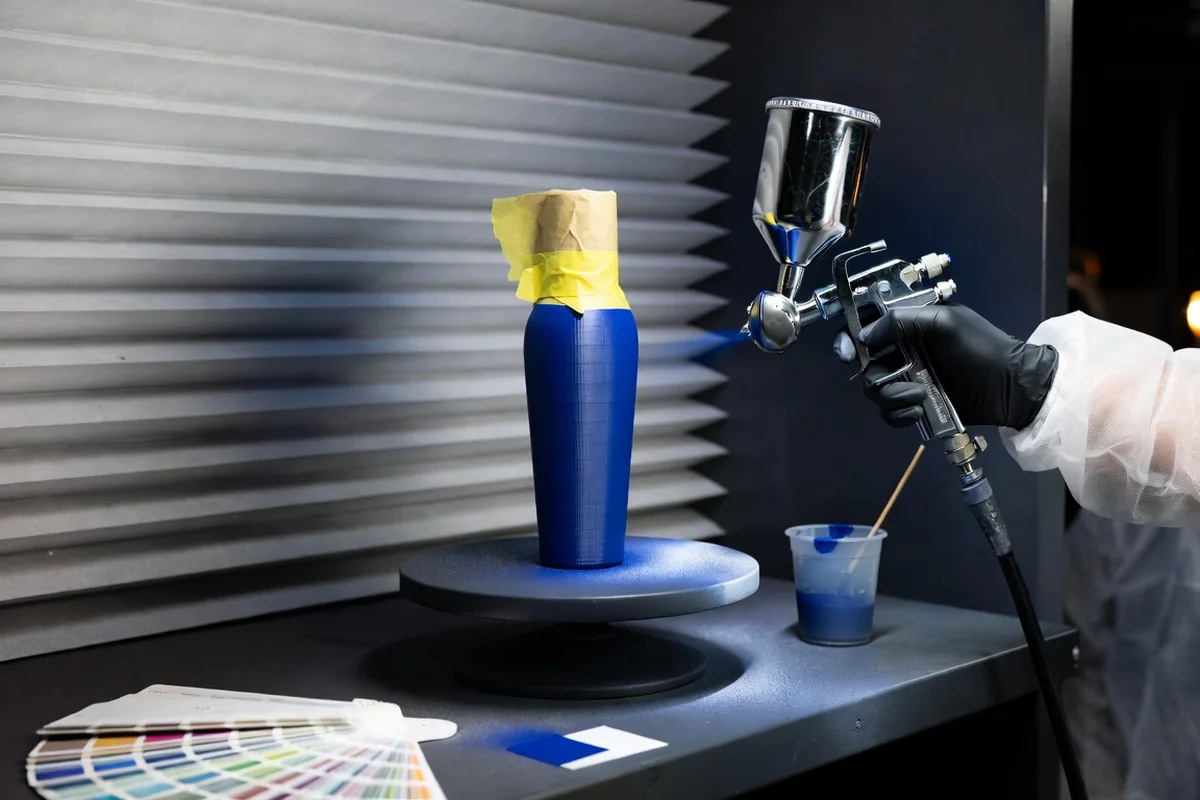
Brand models, packaging mockups, display props and color-coded teaching models all need color that is exact and survives handling. On our floor that color is applied in a paint shop after the part is printed. The sequence below is the same for a bottle cap and a life-size figure.
1. Print in the process that suits the shape
Color does not choose the printer. Geometry does. Fine detail and smooth faces go to SLA resin, large economical forms to FDM, and complex or interlocking shapes to SLS nylon. All three take paint.
2. Prepare the surface
Paint shows everything under it. Parts are sanded to knock down layer lines, then primed so the color coat grips and the surface is uniform. This is also where the one trade-off appears: primer and paint are a real coating, so very fine surface texture can soften slightly. Detail-critical areas are flagged with you before spraying.
3. Lock the sheen, then mix
Gloss, satin and matte change how the same color reads to the eye, so the finish is chosen first and the color is judged in that finish. For brand work, paint is mixed to the Pantone code you supply, with the current Pantone Solid Coated guide as the reference. Because the color is mixed and not printed, bright, deep and pale colors are all available.
4. Mask for multiple colors
A two-color part is sprayed in stages, with masking between zones to keep the edges crisp. Where the design allows it, separate pieces are sprayed individually and assembled afterward, which gives the cleanest line of all. If you are still designing, put the part breaks where the colors change.
5. Seal
A clear coat in the chosen sheen protects the color. The result is a surface meant to be picked up, passed around a meeting and packed for a show.
6. Check against the chip
Before a color-matched part is boxed, it is compared with the physical Pantone chip under consistent lighting, and it ships only when the two agree. Screens are not used as a reference, because every monitor displays color differently. More on the process is on the Pantone color matching page.
Design choices that make painting easier
- Avoid deep, narrow cavities a spray cannot reach evenly, or split the part so they open up.
- Put seams and part breaks on color boundaries.
- Mark which faces are seen and which are hidden.
- List every color with its code, and the finish for each.
If you searched for full color 3D printing
Some machines print color directly into the part, including photographic textures. We do not run that process. Printed-in color suits photo-textured replicas of scanned objects, and for those jobs we say so before you order. For solid colors, multi-color schemes and exact brand matches, a painted part gives stronger color and a sealed surface. The service is described on the full color 3D prints page.
What to send
The model, each color as a PMS code or a physical reference, the finish, the quantity and the date. Runs of matching parts are sprayed to the same code, so quantity shapes the plan. Painted pieces that also need assembly, lighting or mixed materials move on to custom fabrication in the same shop.
PANTONE® is a trademark of Pantone LLC. RapidForge 3D is not affiliated with Pantone LLC; we match colors against Pantone's physical color standards.
Have a model and a set of PMS codes?
Upload the file and list the colors in the notes. The quote comes back with the finish options.